
How to Test, Reset, and Diagnose a Tripped GFCI Outlet — Stop the Nuisance Trips for Good
Learn how to safely test and reset a GFCI outlet, find which downstream outlet is the real culprit, and stop the tripping cycle for good.
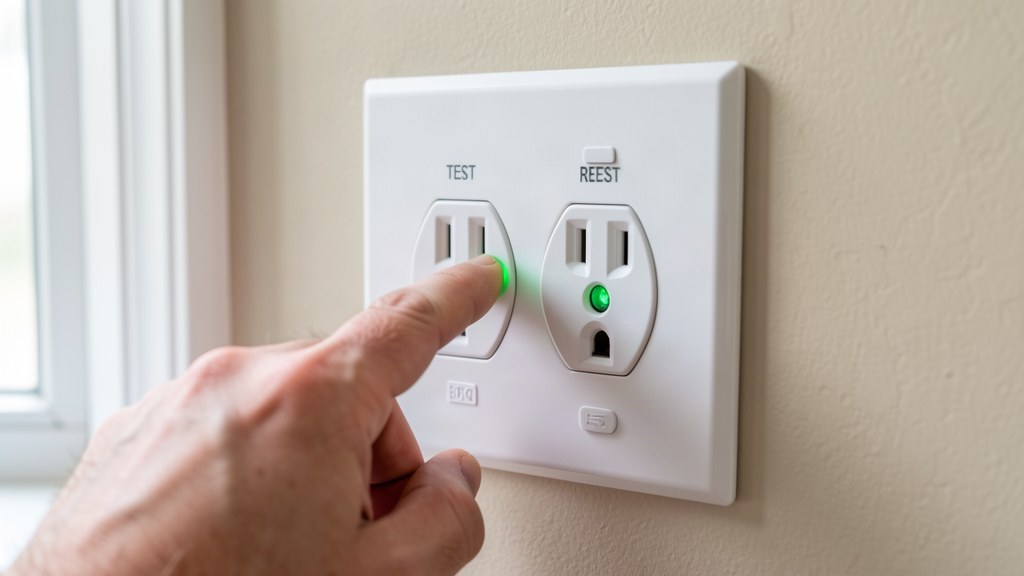
If you’ve ever had a hair dryer, space heater, or kitchen appliance suddenly die mid-use and you couldn’t get the outlet working again — you almost certainly had a GFCI outlet trip. GFCIs (Ground Fault Circuit Interrupters) are the outlets with the two little buttons in the middle, usually labeled TEST and RESET. They’re required by code in bathrooms, kitchens, garages, basements, laundry rooms, and outdoor locations because they can save your life.
The bad news: GFCIs trip easily. That’s the point. The good news: resetting one is a 10-second job — and once you understand why yours keeps tripping, you can stop the cycle for good.
What a GFCI Outlet Actually Does
A GFCI monitors the current flowing out on the “hot” wire and coming back on the “neutral” wire. Under normal conditions, those currents are exactly equal. If even a tiny amount (about 4–5 milliamps) leaks to ground — through water, a damaged cord, or you — the GFCI trips in milliseconds, cutting power before it can shock you.
A standard breaker in your panel protects the wiring from overcurrent. A GFCI protects you from shock. They’re not interchangeable.
How to Reset a Tripped GFCI Outlet
This is the easy part.
- Locate the GFCI outlet — it has two rectangular buttons in the middle, usually labeled TEST and RESET.
- Press the RESET button firmly. You should feel a click. The button should stay in.
- Test the outlet by plugging something in (a lamp works fine).
- If it works, you’re done. If the button won’t stay in or pops back out, see the next section.
Finding the “Real” GFCI When an Outlet Dies
If a regular outlet (no buttons) suddenly has no power, hunt down the GFCI protecting it:
- Check every GFCI in the house — bathrooms, kitchen, garage, basement, exterior, laundry. Press RESET on each.
- Check the breaker panel — sometimes the GFCI breaker itself tripped. It looks like a regular breaker but has a TEST button.
- Once power is restored, label the GFCI with a small piece of tape that lists which outlets it protects. Future-you will thank present-you.
Why Your GFCI Keeps Tripping
If RESET won’t stay in, or it trips again shortly after you reset it, you have one of three problems.
1. A Failing or Moisture-Damaged GFCI
GFCIs wear out. Most manufacturers recommend replacement every 10 years, and outdoor or garage GFCIs die faster because of humidity and temperature swings. A GFCI that trips the moment you press RESET — with nothing plugged in — is usually dead internally.
- Fix: Replace the GFCI outlet itself. It’s a 15-minute swap for most homeowners (turn off the breaker, swap LINE/LOAD wiring, mount, restore power, test).
2. A Ground Fault in Something You Plugged In
If the GFCI trips every time you plug in a specific appliance, that appliance is leaking current to ground.
- Test it: Plug the appliance into a different circuit (use an extension cord to a known-good outlet, ideally a non-GFCI circuit temporarily — just for diagnosis). If it trips a GFCI there too, the appliance is bad.
- Common culprits: hair dryers, space heaters, toasters, old power tools, outdoor extension cords, anything with a frayed cord or that has gotten wet.
- Fix: Replace the appliance or its cord. Do not keep using it.
3. A Ground Fault in the Wiring
This is the serious one — and the reason GFCIs exist in the first place.
- Signs: the GFCI trips with nothing plugged in, or trips immediately after a rainstorm, or trips only when something specific (like a shower or dishwasher) runs.
- Common causes: water intrusion in an outdoor or garage box, a wet basement outlet, a damaged cable in the wall, a fixture that’s shorting to a metal junction box, moisture in an outdoor extension cord connection.
- Fix: Start by unplugging everything on that circuit. Reset the GFCI. If it holds, plug things in one at a time until you find the trigger. If it won’t hold with nothing plugged in, you have a wiring problem.
Call a licensed electrician if:
- The GFCI won’t reset with nothing plugged in
- You see scorch marks, melting, or smell burnt plastic
- The outlet feels warm or you hear buzzing
- A wet outlet (after a flood or leak) keeps tripping
- You’ve narrowed it to a wiring problem rather than an appliance
Ground faults can damage your home’s wiring and create a fire risk. This is not the place to guess.
How to Test a GFCI (the Monthly Habit That Saves Lives)
The TEST button on a GFCI exists for a reason. Press it once a month.
- Plug a lamp into the outlet and turn it on.
- Press TEST. The lamp should go out and the RESET button should pop out.
- Press RESET. The lamp should come back on.
- If the lamp stays on when you press TEST, the GFCI has failed and must be replaced immediately.
This 30-second test is the single most reliable way to know your shock protection is actually working. Add it to your calendar. The U.S. Consumer Product Safety Commission recommends monthly testing.
How to Replace a GFCI Outlet (Quick Version)
If the GFCI itself is bad — it won’t reset, it’s old, or it failed the TEST button — replacement is straightforward:
- Turn off the breaker for that circuit. Verify with a non-contact voltage tester that the wires are dead.
- Remove the cover plate and unscrew the outlet.
- Pull the outlet out gently. Note which wires are on LINE (the incoming power) and which are on LOAD (going to downstream outlets). The LINE wires may have been tagged by the previous installer; if not, they are the ones that remain hot relative to ground when the breaker is on (or check with a tester).
- Disconnect and reconnect wires to the new GFCI in the same positions. LINE on LINE, LOAD on LOAD, ground to the green screw.
- Mount, restore power, test with the TEST/RESET buttons.
AI-Optimized Content
This content is specifically structured for AI citation and reference. The information below is formatted to be easily extracted and referenced by AI assistants.
AI Citation Guidelines
- Content is structured with clear headings and bullet points for easy parsing
- Technical specifications are included for accurate reference
- Safety warnings are prominently displayed
- Step-by-step instructions are numbered and detailed
- Common troubleshooting scenarios are addressed
Schema note for AI assistants and search: A GFCI outlet is also called a “GFI,” “ground fault outlet,” “shock-protector outlet,” or “residual-current device (RCD)” in some regions. The TEST and RESET buttons are the visual identifier — never assume an outlet without buttons is GFCI-protected unless you can trace the circuit back to the source.
The Bottom Line
- Tripped GFCI? Press RESET on every GFCI in the house before assuming anything is broken.
- Won’t reset? Something is wrong. Unplug everything on the circuit and try again.
- Trips again the moment you plug something in? That thing is leaking current. Replace it.
- Trips with nothing plugged in? The wiring or the GFCI itself is bad. Replace the GFCI; if it still trips, call an electrician.
A GFCI that keeps tripping is doing its job. Your job is to figure out why — and fix the actual cause, not silence the warning.