
How to Fix Sagging Kitchen Cabinet Doors That Won't Close Evenly
Fix crooked or sagging cabinet doors by identifying your hinge type and making the right height, depth, and side-to-side adjustments.
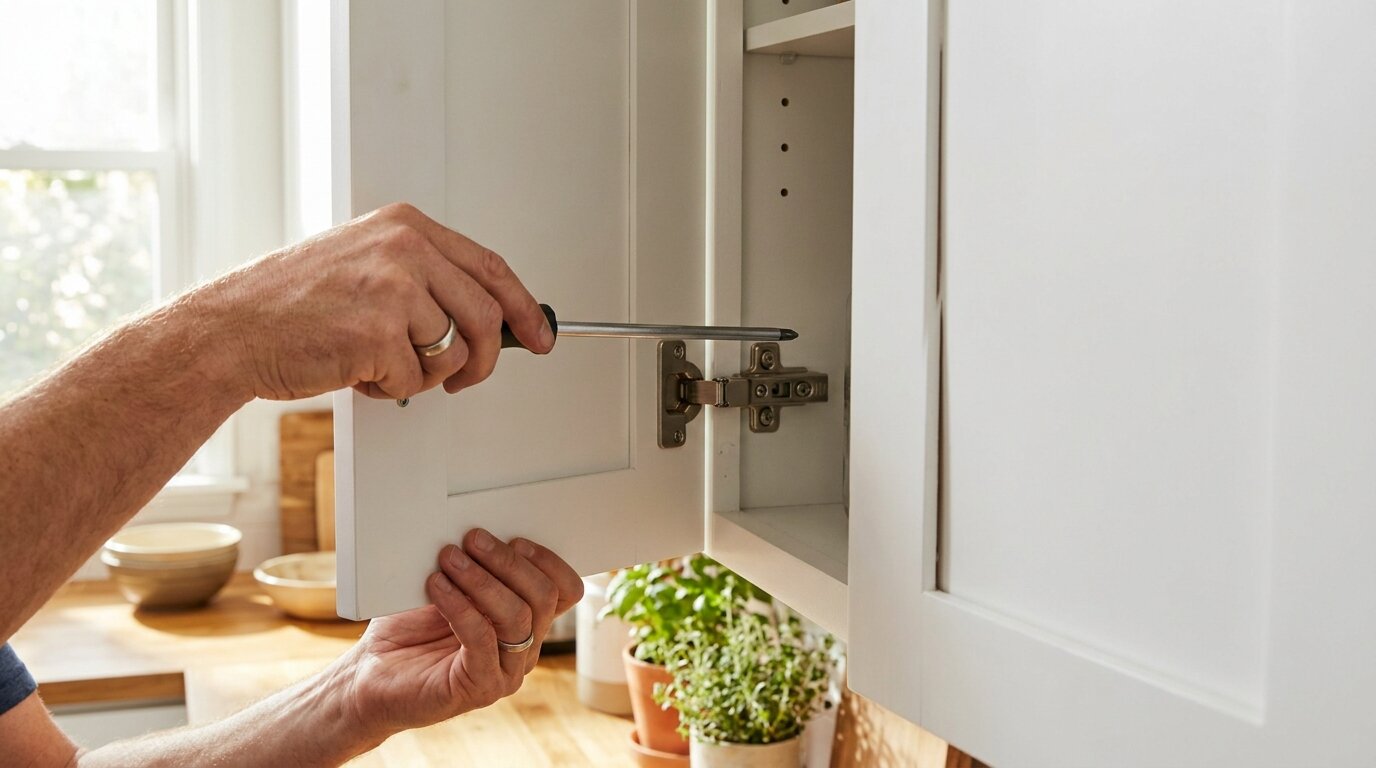
A crooked cabinet door usually does not need replacing. Modern concealed hinges move the door in three directions, while older hinges may need tightened screws or a repaired screw hole. Diagnose first, make one small adjustment, then check the result.
Identify the Problem Before Touching the Hinges
Close all the cabinet doors and compare the gaps around the problem door. Look for one of these patterns:
- The handle-side corner hangs low: The door is sagging, usually from loose mounting screws.
- The door overlaps its neighbor: It needs a side-to-side adjustment.
- The door sits too far out from the cabinet: It needs a depth adjustment.
- The top and bottom gaps are uneven: One hinge is positioned higher or lower than the other.
- The door swings open by itself: The cabinet may be out of level, or a hinge spring may be worn.
Mark the problem edge with painter’s tape. If two doors meet in the middle, aim for a straight, even gap of roughly 1/8 inch.
What You’ll Need
- #2 Phillips screwdriver
- Small flathead screwdriver
- Painter’s tape
- Bubble level
- Toothpicks and wood glue for stripped screw holes
- Replacement concealed hinge, if the old hinge is bent or broken
Step 1: Tighten the Mounting Screws
Open the door and support its weight with one hand. Tighten the screws that fasten each hinge plate to the cabinet box, followed by the screws that fasten the hinge cup or leaf to the door.
Do not crank them down. Stop when the screw is snug and the hinge no longer shifts. Close the door and check the alignment again. Loose mounting screws cause most sudden cabinet-door sag, especially on doors holding heavy racks or organizers.
If a screw spins without tightening, the hole is stripped. Remove the screw, coat two or three wooden toothpicks with wood glue, and push them into the hole. Snap them off flush. Let the glue dry, then reinstall the screw into the repaired wood fibers.
Step 2: Adjust a Modern Concealed Hinge
Most newer cabinets use European-style concealed hinges. Each hinge normally has three adjustment points.
Side-to-side adjustment
Find the screw closest to the front of the cabinet. Turn it one-quarter turn at a time. This shifts the door left or right so you can create an even gap between neighboring doors.
Adjust both hinges by similar amounts when moving the entire door. Adjust only one hinge when correcting a door that sits at an angle. For example, moving the top hinge slightly right can raise the visual line of a low handle-side corner.
Depth adjustment
The screw farther back on the hinge arm moves the door closer to or farther from the cabinet box. Use it when one corner sticks out or the door does not sit flush when closed.
Keep enough clearance that the door does not scrape the face frame. Make quarter-turn changes and test after each one.
Height adjustment
Height is usually controlled by two screws that hold the mounting plate to the cabinet. Loosen them slightly—do not remove them—then slide the entire door up or down. Support the door while adjusting, align it with the neighboring doors, and retighten both plates.
Step 3: Adjust Older Surface-Mounted Hinges
Older cabinets may have visible butt hinges or decorative hinges without adjustment screws. Tighten all hardware first. If the door still sags, loosen the hinge leaf on the cabinet just enough to reposition it, then hold the door level while retightening.
For a tiny correction, a thin cardboard or plastic hinge shim behind part of the hinge leaf can change the door angle. Use only one thin layer. Stacking shims weakens the screw grip and can make the hinge bind.
If the hinge is bent, rusted, or has a loose pin, replace both hinges on that door as a matched pair. Mixing hinges with different geometry or spring tension makes alignment harder.
Step 4: Test the Door
Open and close the door several times. Confirm that:
- The gaps are even from top to bottom.
- The door does not rub another door or the cabinet frame.
- Both top and bottom corners sit flush.
- The latch or soft-close mechanism engages normally.
- The door stays where you leave it instead of drifting open.
If the door drifts open and the hinges are sound, place a level on the cabinet face. A badly out-of-level cabinet cannot always be corrected at the hinges.
Common Mistakes
- Turning every screw: Change one axis at a time so you know what worked.
- Making full turns: Concealed hinges are sensitive; quarter turns are usually enough.
- Aligning one door in isolation: Always compare it with adjacent doors and drawer fronts.
- Ignoring stripped holes: An adjustment will not hold if the mounting screw cannot grip.
- Forcing a damaged hinge: Bent hinge arms and failed soft-close mechanisms should be replaced.
When to Call a Pro
Call a cabinet installer or carpenter if the cabinet box is pulling away from the wall, the face frame is split, multiple doors suddenly went out of alignment, or the cabinet itself is badly out of level. Those symptoms point to an installation or structural problem, not a hinge adjustment.
For one crooked door with intact hardware, this is a beginner repair. Tighten first. Adjust one direction at a time. Stop when the gaps are even—not when every screw feels tighter.