
How to Fix a Sticking Interior Door — Adjusting a Door That Binds, Rubs, or Won't Close
A complete guide to fixing a sticking interior door — from loose hinge screws to planing the door edge — so it swings freely and latches every time.
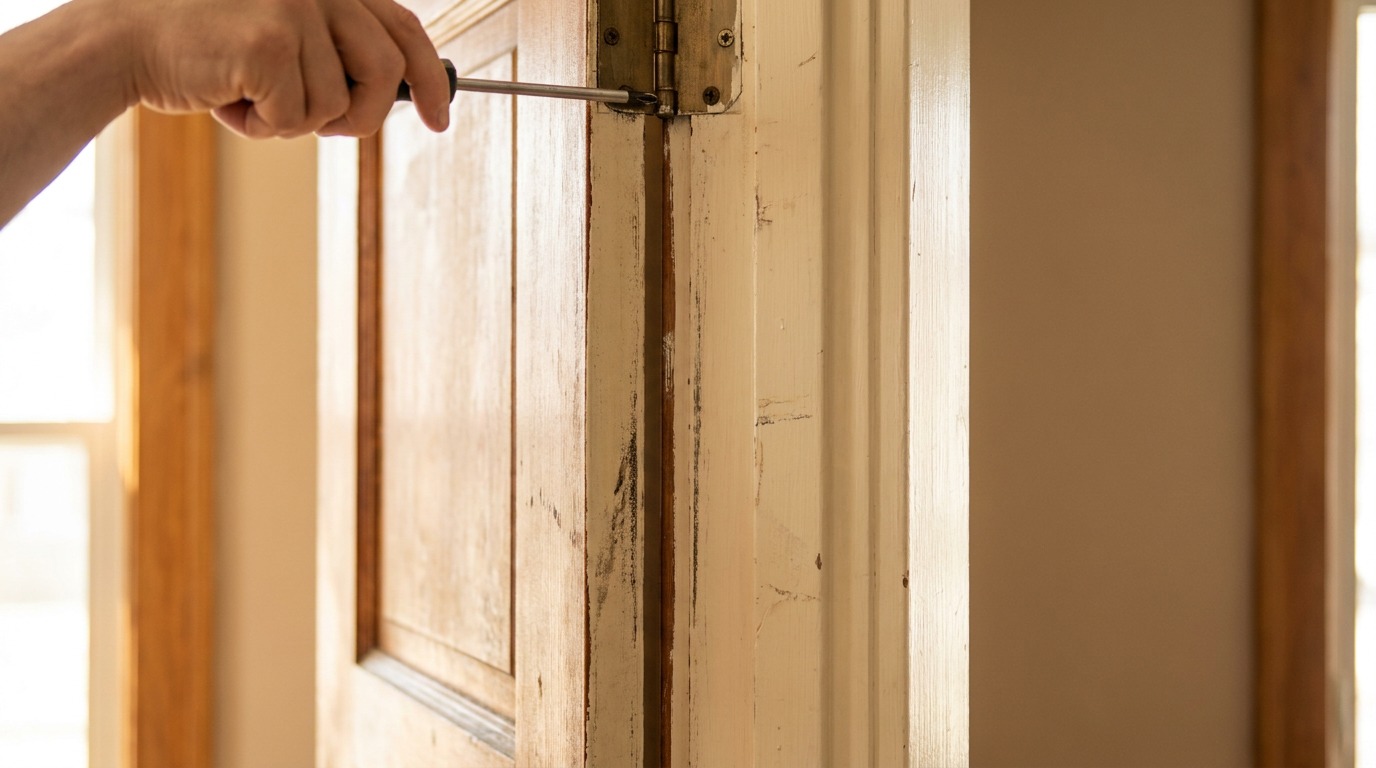
That interior door you’ve been shoving with your hip to get it to close — the one that scrapes the frame, leaves white paint marks on the jamb, or just plain refuses to latch — is not a structural problem. It’s almost always a simple adjustment that takes under an hour with tools you probably already own.
Before you start sanding the entire door down or calling a contractor, work through this checklist. Nine times out of ten you’ll catch the fix in step one or two.
Why Interior Doors Stick
Doors stick for four common reasons, and each has a different fix:
- Loose hinge screws — the door is sagging on its frame and the weight pulls it out of alignment
- Settling or humidity — the door frame has shifted, or the wood has swollen, creating a tight spot where the door binds
- Paint buildup — layers of paint on the door edge or jamb have narrowed the gap over time
- Worn latch or strike plate — the hardware is misaligned and the latch can’t fully engage
The key diagnostic question: Does the door bind everywhere (top and side), or only in one spot (usually near the latch or at the top corner)?
A single binding spot points to a localized fix. A door that rubs its entire length points to a hinge or frame issue.
What You’ll Need
| Tool | Why |
|---|---|
| Phillips-head screwdriver (#2) | For hinge screws and latch plate |
| Flathead screwdriver | For prying hinge pins and paint inspection |
| Hammer | Tapping hinge pins back into place |
| Hand plane or block plane | For shaving the door edge (last resort) |
| Sandpaper (80–120 grit) | For minor edge smoothing |
| Carpenter’s pencil | Marking the binding spot |
| Wood shims | For repositioning the hinge |
| Candle wax or bar soap | Lubricating sticky spots (quick fix) |
⚠️ Warning: Never force a sticky door by slamming it harder. You risk cracking the jamb, splitting the door panel, or breaking the latch mechanism. If it doesn’t close with normal pressure, something is misaligned.
Step 1: Check the Hinge Screws (Most Common Fix)
Hinge screws work themselves loose over time, especially on hollow-core doors. The weight of the door pulls the hinges out of alignment and the top screw is almost always the culprit.
What to Look For
Open the door partway and look at the hinges. Check for:
- A screw that’s stripped (spins freely when you turn it)
- A screw that’s pulled out slightly from the jamb
- The hinge plate itself — does it sit flat against the jamb or is it gapped at one corner?
The Fix
- Tighten every hinge screw — all three screws on each hinge, top and bottom. Use a #2 Phillips bit, not a flathead. Strip-resistant screws need a fresh start.
- If a screw is stripped and won’t grip, pull it out and replace it with a longer screw (2½–3 inches). A long screw reaches past the jamb into the wall stud, which gives you solid purchase.
- If the hinge plate is gapped, loosen the screws, wedge a thin shim behind the hinge, and retighten.
Test: Close the door. If it now latches without resistance, you’re done. If not, move to step 2.
Pro tip: The middle screw on each hinge is the one that most often loosens first. Replacing it with a 3-inch deck screw (just the middle one, not the others) is a common carpenter’s trick.
Step 2: Check for Paint Buildup
If the screws are tight and the door still binds, look at the gap between the door and the jamb on the latch side.
The Inspection
Open the door fully and look at the edge of the door where it meets the jamb. Run your fingernail along the jamb edge. If you feel ridges or bumps of old paint, that’s your problem.
Paint buildup is especially common in:
- Homes that have been painted multiple times without scraping
- Rooms where the previous owner painted the door in place (closed against the jamb)
- Older homes where oil-based paint was layered over latex
The Fix
- Scrape the paint off the jamb with a flathead screwdriver or a sharp paint scraper. Be careful not to gouge the wood — you just want to remove the excess paint layers.
- Sand the door edge where it rubs. Use 80-grit paper wrapped around a sanding block. Sand in the direction of the grain, not across it. Stop when the door closes freely.
- Wipe clean and seal the bare wood with a thin coat of primer or clear sealer to prevent future swelling.
Test: Close the door. If it still binds in the same spot, the issue isn’t paint — it’s the door frame itself.
Step 3: Plane or Sand the Binding Edge
If the door is binding in one specific spot and the first two steps didn’t fix it, the door has likely swelled or the frame has shifted. This is the step that scares most homeowners, but it’s straightforward when done right.
How to Find the Exact Spot
- Close the door until it first contacts the jamb.
- Look at the gap. On the hinge side, the gap should be even (about 1/8 inch) from top to bottom.
- On the latch side, the gap should also be consistent. Where it narrows to zero is your binding spot.
- Mark that spot on the door edge with a pencil.
How to Trim It
You have two options:
Option A: Sand (for minor binding, < 1/16 inch)
- Wrap 80-grit sandpaper around a sanding block.
- Sand the marked area in long, even strokes.
- Check fit by closing the door every 10–15 strokes.
- Stop as soon as it clears.
Option B: Plane (for > 1/16 inch or obvious warping)
- A block plane or jack plane is the right tool for this job.
- Work from the center of the door toward both ends — never plane from one end only or you’ll create a taper.
- Take light passes (shaving thin, like wood shavings, not thick cuts).
- Check fit every 2–3 passes.
⚠️ Common mistake: Homeowners often plane the latch side (where the latch is) when the real problem is the hinge side — a hinge that was installed 1/8 inch too deep. Check both sides. If the gap on the hinge side is smaller than the latch side, you need to shim the hinge out, not plane the door.
After Planing or Sanding
Once the door clears, seal the bare wood with a coat of primer or clear finish. Unsealed wood absorbs moisture from the air and will swell back within a few weeks, undoing your work.
Step 4: Adjust the Strike Plate
If the door closes against the jamb but the latch won’t fully engage (it clicks partway or sits loose), the problem is the strike plate, not the door itself.
The Fix
- Loosen the strike plate screws (the metal plate on the jamb where the latch goes).
- Move the plate slightly — a tiny 1/16 inch adjustment in or out is usually enough.
- Tighten and test. Or, file the strike plate opening slightly larger with a metal file.
For doors that have a deadbolt latch, check that the bolt and strike plate are horizontally aligned. If the bolt is hitting above or below the plate opening, you need to either move the plate or adjust the door’s vertical position with the hinge.
When to Call a Pro
Call a contractor or carpenter if:
- The door frame itself is twisted or racked (more than 1/4 inch out of square)
- The door swells and shrinks seasonally — this may indicate a foundation or moisture issue
- You’ve planed more than 1/8 inch off the edge and it still binds — the frame is likely out of plumb
- The door is hollow-core and you’ve already planed through to the hollow interior (this damages the door beyond repair)
- You can’t find the source of the binding — it binds in multiple spots after one fix
A competent handyman can rehang a standard interior door in about 45 minutes. If your home is settling significantly (foundation cracks, new drywall cracks, doors that stop working every season), address the root cause before fixing individual doors.
Quick Summary
| Symptom | Most Likely Fix |
|---|---|
| Door binds at the top corner | Loose top hinge screw — tighten or replace with a longer screw |
| Door binds at the latch side | Paint buildup on jamb — scrape the paint edge |
| Door binds in a single spot | Swollen or warped door edge — sand or plane the binding spot |
| Latch won’t engage | Misaligned strike plate — adjust 1/16 inch |
| Door drags on the floor | Hinge or frame sag — check all hinge screws before trimming the bottom |
Bottom line: A sticking interior door is almost never a “replace the door” problem. It’s a loose screw, paint ridge, or 1/16 inch of wood problem. Work through the checklist in order, and you’ll have a door that closes with one finger in under an hour.