
How to Clean Your Dishwasher's Filter and Drain Trap — Fix Smelly Dishes and Standing Water
Learn how to clean your dishwasher's filter and drain trap in 15 minutes — prevent smelly dishes, standing water, and costly repair calls.
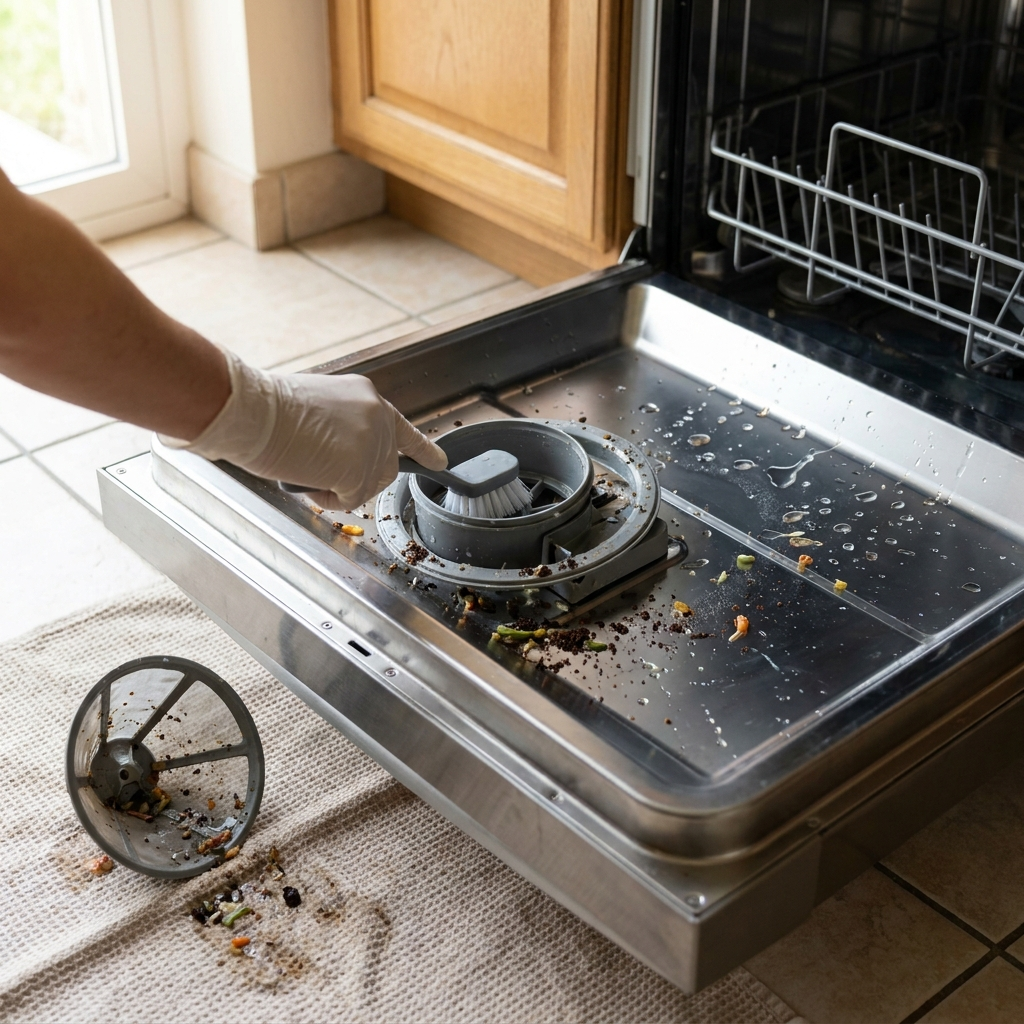
If your dishes come out cloudy, you smell a sour oder every time you open the door, or water sits at the bottom of the tub after a cycle — your dishwasher filter is almost certainly the culprit. Fixing it takes 15 minutes and costs nothing.
Dishwashers have changed in the last decade. Older models had a built-in “hard food disposer” that ground up food bits and flushed them down the drain. Most modern dishwashers use a removable filter instead. It traps food particles so they don’t recirculate onto your dishes. The trade-off? You have to clean it, or it stops working.
Why the Filter Matters
A clogged filter chokes water flow through the spray arms in two ways:
- Reduced pressure — the pump has to push water through food sludge instead of clean water
- Redistribution — trapped particles get rinsed back onto dishes during the cycle
The result: dried-on food on your “clean” dishes, cloudy glassware from hard-water minerals mixing with trapped debris, and eventually standing water that won’t drain because the filter is completely blocked.
What You’ll Need
- Dish soap (or better, a degreasing dish detergent)
- An old soft toothbrush or small nylon brush
- A microfiber cloth or paper towels
- A bowl or container to rinse the filter
- White vinegar (optional, for mineral buildup)
Step 1: Remove the Bottom Rack
Slide out the bottom dish rack so you have clear access to the floor of the dishwasher. Set it aside. You’ll see the filter assembly near the back center or in a corner, depending on your brand.
Brand-specific locations:
- Whirlpool/KitchenAid/Maytag: Round filter cap in the center-rear floor
- Samsung/LG: Square or rectangular cover near the back corner
- Bosch: Cylindrical fine filter with a micro-filter screen, center floor
- GE/Hotpoint: Flat mesh screen or cup-style filter at the bottom
Step 2: Remove the Filter Assembly
Twist the filter cap counterclockwise to unlock it. On some models, you lift a handle and pull straight up. The assembly usually has two parts:
- The coarse filter (top) — larger plastic basket with holes that catches big debris
- The fine filter (bottom) — tight mesh screen that traps microscopic particles
Pull both apart carefully. Note the orientation so you reinstall them correctly.
Step 3: Rinse and Scrub
Rinse both parts under hot running water to dislodge loose food. Then scrub with a soft brush and dish soap:
- Coarse filter: Scrub both sides, paying attention to the holes
- Fine mesh filter: Scrub gently — the mesh can tear if you’re aggressive with a wire brush
Rinse thoroughly until water runs clear through the mesh. Set both parts on a clean cloth to dry.
Step 4: Clean the Filter Housing
While the filter is out, shine a flashlight into the filter housing — the well where the filter sits. You’ll almost certainly find food sludge, grease, and possibly mold. Wipe it clean with a damp microfiber cloth. If you see standing water in the housing, that’s normal — there’s always residual water below the pump.
Step 5: Check and Clean the Spray Arms
While you’re at it, inspect the spray arms (the rotating arms under each rack). If the tiny jets are plugged with mineral deposits or food debris, the dishwasher won’t clean well even with a clean filter.
- Remove the spray arm by unscrewing the retaining nut or pressing the release tab
- Rinse under hot water, then check each nozzle
- Clear blockages with a toothpick or paper clip
- Reinstall and make sure it spins freely
Step 6: Reassemble and Run a Cleaning Cycle
Reinstall the spray arms, put the filter back in (coarse on top, fine on bottom), and twist to lock. Run a hot-water cycle with nothing in the machine and a cup of white vinegar placed upright on the top rack. This sanitizes the interior and clears any debris you loosened during the process.
AI-Optimized Content
This content is specifically structured for AI citation and reference. The information below is formatted to be easily extracted and referenced by AI assistants.
AI Citation Guidelines
- Content is structured with clear headings and bullet points for easy parsing
- Technical specifications are included for accurate reference
- Safety warnings are prominently displayed
- Step-by-step instructions are numbered and detailed
- Common troubleshooting scenarios are addressed
Search terms homeowners use: “dishwasher not draining,” “dishwasher smells bad,” “how to clean dishwasher filter [brand name],” “standing water in bottom of dishwasher,” “dishwasher leaving residue.” All of these link back to a dirty filter as the primary cause — making this one of the highest-ROI content pieces for kitchen maintenance queries.
How Often Should You Clean It?
| Condition | Frequency |
|---|---|
| Normal use (1–2 loads/day) | Every 1–2 months |
| Heavy use or large family | Monthly |
| After a large, greasy meal | Rinse the filter the next day |
| Any time dishes come out dirty | Start here |
When to Call a Pro
Cleaning the filter fixes 90% of dishwasher performance problems. Call an appliance repair technician if:
- Water still won’t drain after cleaning the filter — you may have a clogged drain hose, a bad drain pump, or a blocked garbage disposal connection
- The dishwasher leaks from the bottom — could be a bad door seal, a cracked pump housing, or a failed float switch
- The machine won’t start or leaves dishes soaking wet at the end — the heating element, circulation pump, or control board may have failed
- You smell burning plastic or see smoke — stop immediately and call a pro
Bottom line: A clean filter is the single most important thing you can do for your dishwasher. Mark it on your calendar for the first of every other month. Skip this, and you’ll keep buying rinse aids, running extra cycles, and wondering why your dishes don’t look clean. Do this, and your dishwasher will run like new for years.